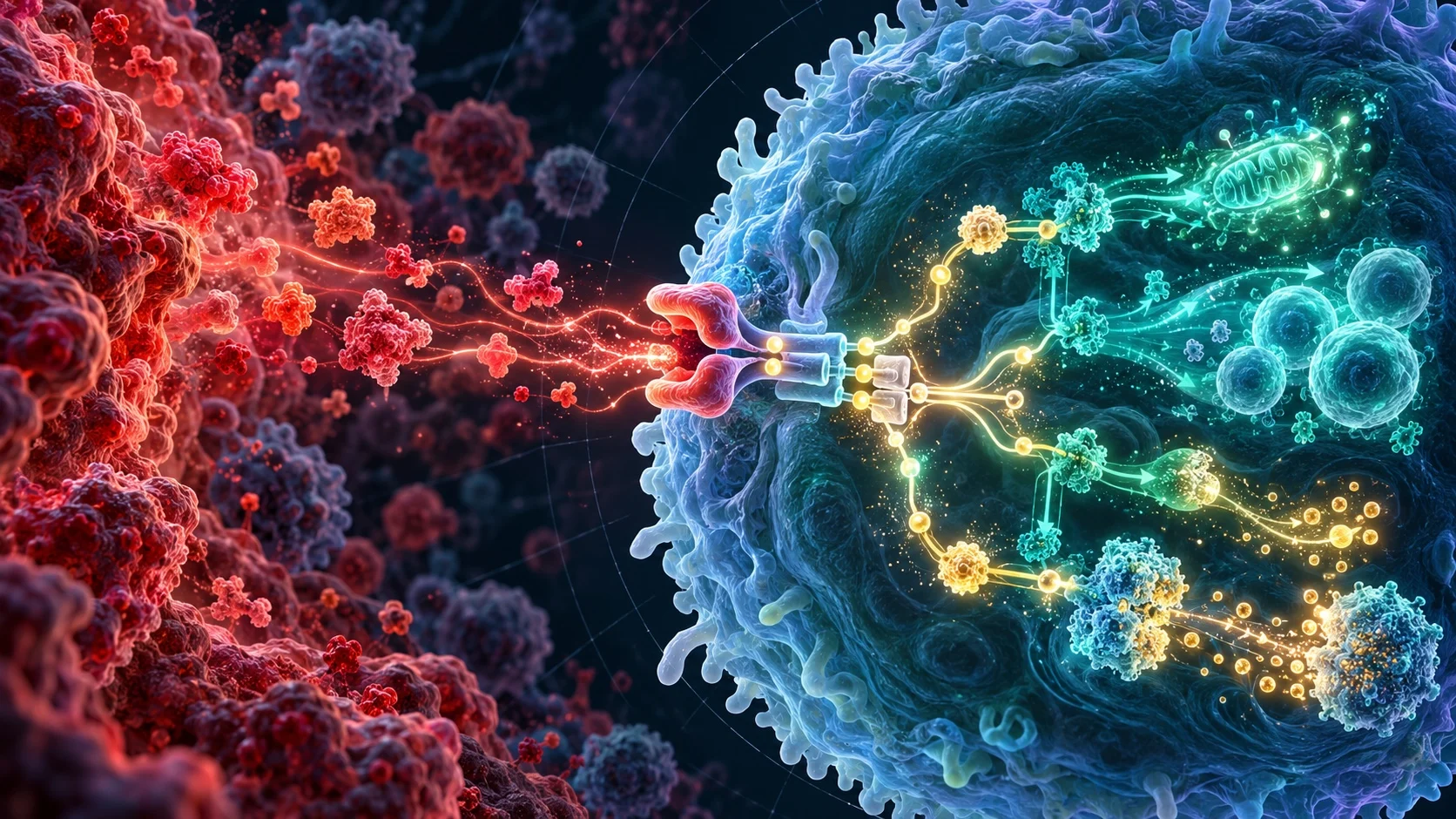
Conceptual illustration of an engineered T cell converting suppressive tumor signals into intracellular survival and activation programs
03 / REWIRE

Turn tumor cues into instructions.

Mechanistic maps become most powerful when they change what a therapeutic cell can do. We build receptors and intracellular programs that recode suppressive environments.

Enter the program ↓
sense → recode → function
The premise

A question with
engineering consequences.

Can a cue that normally disables a T cell become the signal that sustains its survival and function?

Our engineering is grounded in systems-level evidence: identify the bottleneck, establish causality, then design the smallest intervention that changes therapeutic behavior without erasing useful biology.

03 / CAUSAL LOOP

Question to evidence,
without a missing step.

01Question

Which bottleneck should we recode?

Start from a causal failure mode rather than an unconstrained engineering wish list.

02Measure

Define the suppressive input

Quantify how tissue cues alter signaling, metabolism, proteostasis, and cell state.

03Mechanism

Resolve the control point

Establish the smallest molecular intervention capable of changing therapeutic behavior.

04Engineer

Turn cue into function

Build receptors and intracellular programs that preserve adaptation while redirecting fate.

05Evidence

Test the design rule

Link each strategy to peer-reviewed mechanism and preclinical functional evidence.

03EVIDENCE
Published evidence · PNAS · 2025

A TGF-βR/IL-2R immunomodulatory fusion protein transforms immunosuppression into T cell activation to enhance adoptive T cell therapy.

The study engineers fusion proteins that pair TGF-β-receptor extracellular domains with IL-2-receptor signaling domains, then tests whether a suppressive environmental cue can instead support activation, proliferation, and function in engineered T cells.

Suppressive cueReceptor designSignal conversionFunctional testing
Peer-reviewed publication · linked to the publisher recordRead the PNAS paper ↗
03
PROGRAM LOGIC

Observe. Perturb.
Build.

01

Protect cell state

Engineer proteostasis, metabolic, and epigenetic programs that resist exhaustion while preserving adaptive capacity.

02

Convert suppressive signals

Design synthetic receptors that transform hostile tumor cues into survival or activation programs.

03

Build predictive living medicines

Integrate measurement and modeling toward digital physiological twins that make cell behavior more programmable.

Connected scholarship

The papers behind the program.

Each connection is curated to show how published evidence informs the questions, methods, or engineering logic of this research program.

01 · Synthetic signal conversion
PNAS

A TGF-betaR/IL-2R immunomodulatory fusion protein transforms immunosuppression into T cell activation to enhance adoptive T cell therapy

Open publication
02 · TCR-T co-receptor engineering
Nature Communications

A CD8alpha-beta co-receptor modified to contain an intracellular CD28 signaling tail enhances TCR-engineered T cell function independent of solid-tumor-associated co-stimulatory ligands

Open publication
03 · Proteostasis as an engineering axis
Nature

The ubiquitin ligase KLHL6 drives resistance to CD8+ T cell dysfunction

Open publication
Explore the complete publication archive
Experimental toolkit

The methods serve
the mechanism.

01Synthetic receptor design02Protein engineering03CRISPR perturbation04Systems modeling05Preclinical validation
DESIGNED OUTPUTSEngineered circuitsDurable TCR-T cellsDesign rules
NEXT / FROM PROGRAM TO PROOF

See how a systems map
became a mechanism.

Explore the KLHL6 discovery path ↗