01Question
Where does therapeutic fate diverge?
Locate functional and dysfunctional engineered T cells within structured tumor neighborhoods.



Engineered T cells do not fail in isolation. They encounter cellular neighborhoods, metabolic constraints, and molecular gradients that shape fate across space.
Enter the program ↓Where are therapeutic T cells, which neighbors and cues surround them, and which interactions cause functional or dysfunctional fates?
A tumor microenvironment is a structured ecosystem rather than a uniform barrier. We combine spatial measurement with causal perturbation to distinguish descriptive neighborhoods from actionable mechanisms.
Locate functional and dysfunctional engineered T cells within structured tumor neighborhoods.
Combine spatial cell states, tissue composition, and inferred metabolic programs in the same geography.
Test which ligand–receptor and metabolic relationships drive divergent TCR-T-cell states.
Convert actionable spatial mechanisms into rescue strategies and therapeutic targets.
Connect tissue-resolved maps to causal mechanisms, engineered interventions, and the publications that establish each step.
These spatial maps reveal how cellular neighborhoods and metabolic programs shape engineered T-cell fate in pancreatic tumors. Presented in the laboratory’s original scientific palettes, they anchor a research program that moves from tissue-resolved observation to causal mechanism and therapeutic design.
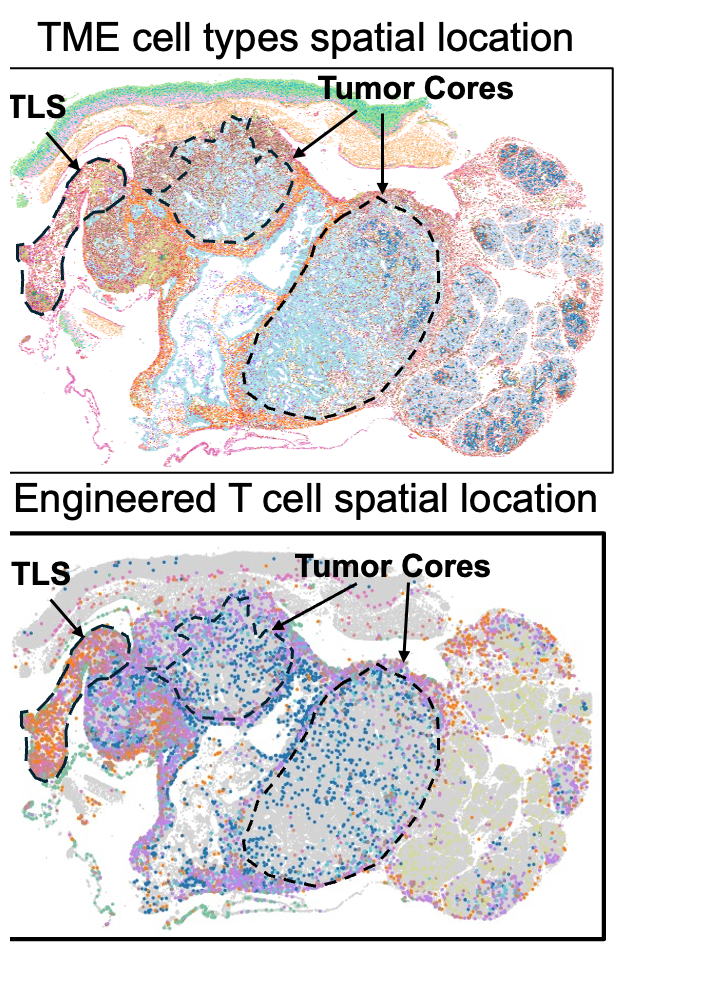 ORIGINAL DATA COLORS
Locate engineered T cells and resolve the native immune, stromal, and tumor cells that define their local context.
Use in vivo Perturb-seq and spatial perturb-omics to measure how a genetic change affects both a T cell and its neighbors.
Infer and validate spatial nutrient and stress programs, including lipid and iron metabolism, that condition T-cell behavior.
Each connection is curated to show how published evidence informs the questions, methods, or engineering logic of this research program.